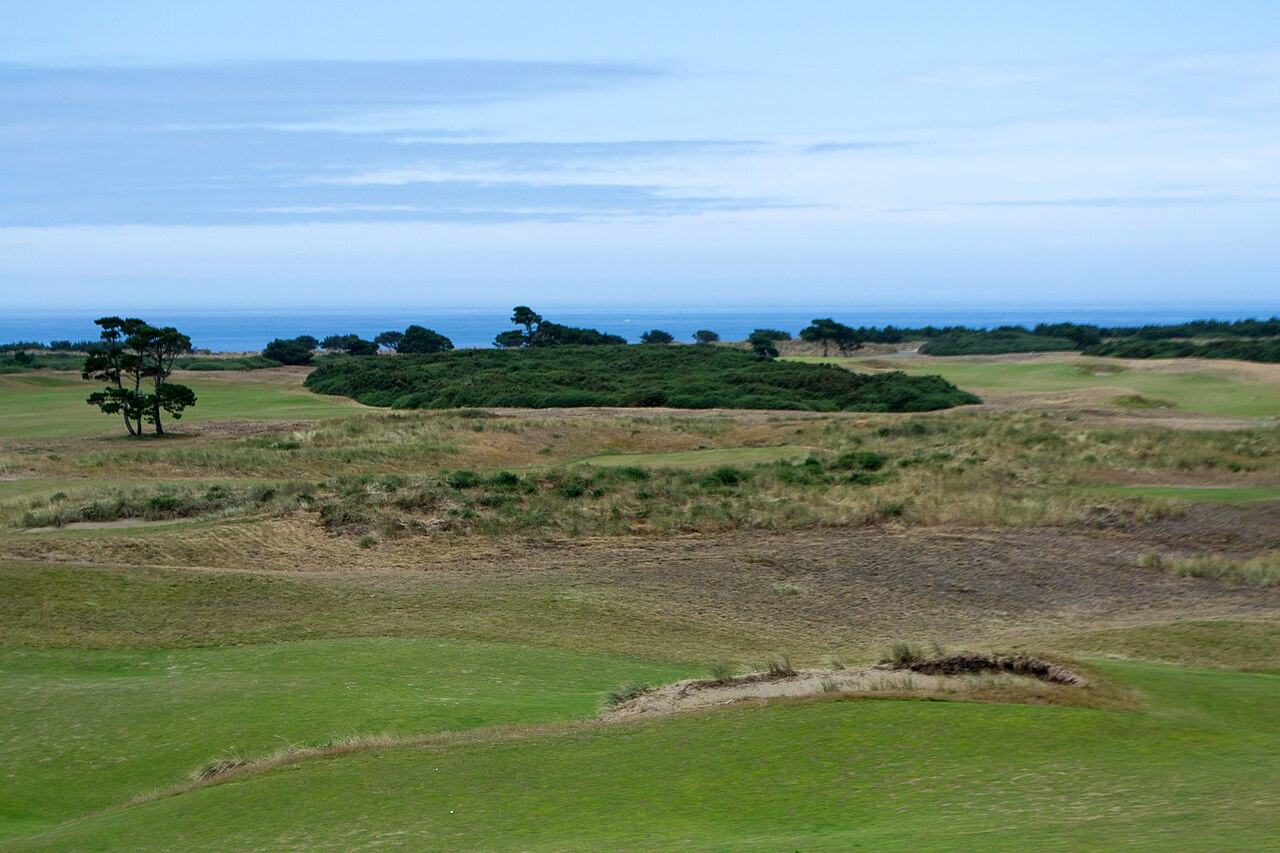
Bandon Dunes Golf Resort is five 18-hole courses and two par-3 courses on the dunes of the southern Oregon coast, all walking only, and it’s the closest thing America has to a week in Scotland. In 2026, resort guests pay $130 to $375 a round depending on the month, day guests up to $475, and peak-season rooms go through a lodging drawing.
The story is part of golf folklore by now. In the 1990s Mike Keiser, who made his money in recycled-paper greeting cards, bought a stretch of gorse-choked dunes more than four hours’ drive from Portland and hired a little-known young Scottish architect, David McLay Kidd, to build a links on it. The first course opened on May 19, 1999. The conventional wisdom was that nobody would fly to the middle of nowhere to walk a course with no carts and no houses. The conventional wisdom was wrong, and the resort has been adding golf ever since: five 18-hole courses, two par-3 courses, a putting course the size of a couple of football fields, and a lot more demand than it has rooms. It hosted the 2006 Curtis Cup and the 2020 U.S. Amateur, and the USGA has championships booked there into the 2040s.
What makes Bandon different isn’t only the golf, though the golf is as good as resort golf gets in this country. It’s the rules. Every course is walking only, all year. There are no homes lining the fairways. The holes run through real dunes, gorse and shore pine, mostly within sight or sound of the Pacific, and the wind decides a lot more than your handicap does. A week here feels less like an American golf vacation than a pilgrimage with very good beer.
This page is the complete guide: the courses ranked and explained, what everything costs in 2026, how the lodging drawing works, how to get there, when to go, how many days you need, and how to add the rest of the Pacific Northwest, from Gamble Sands in Washington to Bend and Coeur d’Alene. It’s the hub for our Bandon and Pacific Northwest guides, so each section points to a deeper page when you need one.
The green fees below are the resort’s 2026 rate tiers as compiled in our research in September 2026, which match the figures reported by Golf For Kings. Where we give a range or an estimate, we say so.
At a glance
- What it is: five 18-hole courses (Bandon Dunes, Pacific Dunes, Bandon Trails, Old Macdonald and Sheep Ranch), two par-3 courses (Bandon Preserve and Shorty’s) and the Punchbowl putting course. Walking only, all year.
- Green fees (2026): resort guests pay $130 (December and January) to $375 (June to September). Day guests pay $180–$425 within 21 days; premium day-guest times run up to $475. Same-day replays are half price.
- Caddies: $100 per bag plus a tip.
- Getting there: United flies to North Bend (OTH), about 30 minutes from the resort, from San Francisco and Denver. Eugene and Medford are about 2¾ hours away by car; Portland about 4½.
- Best time: June to September for the driest weather; May and October for near-summer golf for a little less; December and January for the cheapest rounds and the most rain.
- Lodging: on-site rooms run from single lodge rooms to four-bedroom cottages. Busy periods are allocated by a drawing.
- How long: three or four nights for a first trip, playing 27 to 36 holes a day.
Is Bandon Dunes worth it?
Yes, if your group is happy to walk and wants pure golf. Bandon has five excellent courses, fair green fees for resort guests and almost nothing else to distract you. It isn’t worth it for golfers who need a cart, groups who want nightlife, or anyone who hates wind and rain.
That’s the short version. The longer one comes down to value, the walk and the weather.
Value. The peak resort-guest rate of $375 sounds like a lot until you set it beside the other American bucket-list resorts. Pebble Beach charges $695 for one round from April 2026, and you have to stay at least two nights on the property to book ahead. Pinehurst No. 2 is for resort guests on a package, at $495 to $695 according to The Birdie Report’s 2026 figures. At Bandon, the second round of the day costs half price, and a winter round costs $130. For golf of this quality, that’s close to a bargain, at least by the standards of the bucket-list resorts.
The walk. Every course is walking only, and the ground is sand, dune and the odd steep climb. You’ll cover five to six miles a round, and most visitors play 27 or 36 holes a day. A fit 60-year-old with a caddie will be fine. A group that hasn’t walked 18 since college will be sore by the second afternoon and miserable by the third. If anyone in your group can’t walk for medical reasons, call the resort before you book anything.
The weather. Summer on the southern Oregon coast means highs in the 60s °F, fog some mornings and a north wind that builds most afternoons. Winter brings rain and big storms off the Pacific. There are days when the wind blows so hard you’ll hit a 5-iron 140 yards into it. Some golfers love that. Some golfers hate it and spend the whole trip wishing they’d gone to Scottsdale. Know which kind you are.
Who will love it: single-digit handicaps, architecture nerds, groups of friends who’d rather play 36 than go out, and anyone who has done Scotland or Ireland and wants the same feeling without the overnight flight.
Who should think twice: golfers who ride every round at home, couples where one person doesn’t play (there’s a spa, a beach and a small town, and that’s about it), and groups who measure a trip by its nightlife.
The five courses at Bandon Dunes, ranked
Ranking Bandon’s courses is the resort’s favorite argument, and there’s no settling it. Ask five regulars and you’ll get five lists. Here’s ours, with the reasoning, so you can make your own.
| Our rank | Course | Architect | Opened | What it’s like | Best for |
|---|---|---|---|---|---|
| 1 | Pacific Dunes | Tom Doak | 2001 | Wild and varied, small greens, par 71 with four par 3s on the back nine | The round you’ll remember longest |
| 2 | Old Macdonald | Tom Doak and Jim Urbina | 2010 | Classic “template” holes, huge fairways and enormous greens | Match play and strategy |
| 3 | Bandon Dunes | David McLay Kidd | 1999 | The original links along the bluff | Your first round |
| 4 | Sheep Ranch | Bill Coore and Ben Crenshaw | 2020 | No bunkers, wide fairways, nine greens on the cliff edge | Ocean views and higher handicaps |
| 5 | Bandon Trails | Bill Coore and Ben Crenshaw | 2005 | Dunes, then meadow and coastal forest, then dunes again | Windy days and fresh legs |
Pacific Dunes (Tom Doak, 2001). If you can play only one course, play this one. Doak routed it through the biggest dunes on the property and along the bluff, and he broke a few rules doing it. The par is 71, the back nine has four par 3s, including two in a row at 10 and 11, and the bunkers are ragged blowouts that look as if the wind made them. The greens are small and the shot values change with every gust. It’s regularly ranked among the best public courses in the country, and it’s the course most golfers name when they get home. The only complaint you’ll hear is that it’s so good it makes the rest of your trip feel like a comedown.
Old Macdonald (Tom Doak and Jim Urbina, 2010). A tribute to Charles Blair Macdonald, the father of American golf architecture, built around his “template” holes, copies of famous British holes such as the Redan, the Biarritz, the Alps, the Road Hole and the Punchbowl. The fairways are enormous and the greens are bigger still, so it’s very playable for a mid-handicapper off the tee and very hard to score on if you don’t think about where to miss. It’s the best match-play course at the resort, in our view, because a blow-up costs you only one hole, and the giant greens produce putts long enough to settle a lot of bets.
Bandon Dunes (David McLay Kidd, 1999). The original, and still a terrific links. Kidd’s course runs out and back along the bluff, with long views of the Pacific from the opening holes, and the 16th, a short par 4 played across a chasm in the dunes toward the ocean, is one of the resort’s signature holes. It plays firm and fast in summer and gives you the clearest idea of what the place is about, which is why we’d play it first. It’s also the course where you’ll first realize that a bump-and-run beats a lob wedge here.
Sheep Ranch (Bill Coore and Ben Crenshaw, 2020). The newest of the five has no bunkers, generous fairways and nine greens set on the edge of the cliffs, so it’s the most ocean you’ll see in one round and the friendliest of the five for a high handicapper. For years the site held an informal layout of greens that a few insiders played by invitation; Coore and Crenshaw turned it into a full course. Some critics find it a little light on strategy. Most visitors are too busy looking at the Pacific to notice, and on a calm evening it may be the most beautiful walk at the resort.
Bandon Trails (Bill Coore and Ben Crenshaw, 2005). The odd one out. It starts in the dunes, climbs into meadow and coastal forest, and finishes back in the dunes, so there’s no ocean in play for most of the round. Plenty of regulars rank it first anyway, because the holes are superb and it’s the most sheltered course on a windy day. It’s also the hilliest walk at the resort. Play it on a fresh morning, not as your second round of the day.
The par-3 courses and the Punchbowl. Bandon Preserve, a 13-hole par-3 course by Coore and Crenshaw on a bluff above the beach, is the best way to spend an afternoon when your legs are done. Shorty’s, the newest addition, is a 19-hole par-3 course. Both cost $60 to $125, and the resort says net profits go to the Bandon Dunes Charitable Foundation. The Punchbowl is a giant putting course, designed by Doak and Urbina, where groups settle the day’s bets after dinner.
Our Bandon Dunes courses ranked guide goes hole by hole, with the order we’d play them in each season.
How to play links golf at Bandon
Bandon plays like the British Isles, and most American golfers arrive with the wrong game for it. Their home course rewards a high, spinning approach to a soft green. Bandon punishes it. A few adjustments save a lot of shots and a lot of grief.
Keep the ball low. The wind is the main hazard on every course except Bandon Trails, and a high wedge into a 25-mph breeze goes nowhere good. Take one or two more clubs than the yardage says, choke down and swing easier. The old line “when it’s breezy, swing easy” is old because it works.
Use the ground. The fairways are firm fescue, and the approaches to most greens are open, so a bump-and-run with a 7-iron or a hybrid is often the safest shot from 30 or 40 yards. On Old Macdonald’s huge greens, a putter from well off the putting surface is a perfectly respectable play. Practice that shot at the practice center on your first afternoon and you’ll use it all week.
Stay out of the gorse. The spiny, yellow-flowered shrub that covers the dunes is impenetrable, and a ball that goes into it is gone. It has history here: the town’s founder brought gorse to Bandon from Ireland in the 1800s, and it fueled the fire that burned the town in 1936. Aim away from it, carry a few more balls than you think you’ll need, and don’t go looking.
Play the wind, not the yardage. Caddies talk in “plays like” numbers, and the gap between the card and reality can be huge. A 150-yard shot can play 125 downwind and 185 into a summer gale. Watch the flag, the grass and your playing partners’ shots before you pull a club.
Expect odd bounces. On firm links ground a good shot sometimes kicks into trouble and a bad one sometimes runs onto the green. That’s the game here. The golfers who enjoy Bandon most are the ones who laugh at it.
Adjust your putting. The fescue greens usually run slower than the slick bentgrass at many American clubs, and a strong wind will move a ball on the green. Widen your stance, hit putts firmly, and trust the caddie’s read on your first loop.
Move up a set of tees. Each course has several sets, and the summer wind makes every hole longer. Play one set shorter than you would at home and you’ll hit more of the shots the architects intended.
How much does Bandon Dunes cost in 2026?
Resort guests pay $130 a round in December and January, rising to $375 from June to September, with half-price replays. Day guests pay $180 to $425 within 21 days, or up to $475 for premium times booked earlier. Caddies cost $100 a bag plus tip, and par-3 rounds $60 to $125.
Here are the 2026 tiers in one place.
| Who | When | 2026 fee for 18 holes |
|---|---|---|
| Resort guest | December and January | $130 |
| Resort guest | February, March and November | $175–$225 |
| Resort guest | May and October | $340 |
| Resort guest | June to September | $375 |
| Day guest (booking within 21 days) | Year-round | $180–$425 |
| Premium day guest (booking 21 or more days ahead) | April to mid-November, 10 a.m. or later | Up to $475 |
| Same-day replay | Year-round | 50% of the rate |
| Bandon Preserve and Shorty’s | Year-round | $60–$125 |
| Caddie | Per bag | $100 plus tip |
April sits between the March and May resort-guest rates; check the resort’s calendar for exact dates, because the tiers change on set days. Oregon residents pay resort-guest rates even when they aren’t staying.
Three things make Bandon cheaper than the headline rates suggest. The first is the replay rate: play 36 in July and your second round costs $187.50, so a full day of golf costs $562.50 rather than $750. The second is the shoulder season. February, March and November rounds at $175 to $225 come with weather that’s unpredictable rather than awful. The third is winter. At $130 in December and January, Bandon is one of the great bargains in American golf, as long as you own good rain gear and don’t mind playing a few rounds in it.
The caddie question. A caddie costs $100 per bag, and the tip is on top. GOLF.com’s rule of thumb is to tip at least 20% of the fee, and at destination resorts most golfers give more. We’d take a caddie for your first loop on each course at least, because the greens are hard to read, the wind changes every club, and a good caddie will save you more shots than a new driver. After that, push carts are free at the first tee and work fine.
What a trip costs. Golf is the predictable part. A resort guest playing seven rounds over four days in July, four at full rate and three as replays, spends $2,062.50 on green fees. Add a caddie for the four full-rate rounds and it’s about $2,500 to $2,600 with tips. Lodging is the bigger variable: rooms are priced by building and season, and in peak season you should plan on several hundred dollars a night per room. JEL Golf Travel puts a premium domestic resort trip at $1,800 to $3,500 or more per golfer before flights in 2026, and a peak-season Bandon trip sits at the upper end of that range in our estimate. Winter and shoulder trips cost far less.
Our Bandon Dunes green fees guide tracks every tier through 2027, and Bandon Dunes trip cost builds full budgets for a summer trip, a shoulder trip and a winter trip.
How does the Bandon Dunes lodging drawing work?
For its busiest periods, Bandon splits the calendar into reservation periods, each with a registration window. Entries are drawn at random to set the order of booking requests; if you’re selected, you get an email with your place in line and later a call from a reservationist. Outside drawing periods, you book normally.
The drawings exist because demand outgrew the rooms. As GOLF.com reported when the resort introduced them, the old first-come, first-served system rewarded whoever happened to get through on the phone first. A drawing at least makes the summer weeks a matter of luck rather than speed-dialing, and it gives everyone the same chance.
What that means in practice:
- Enter every window you can. The resort publishes a registration window for each period. Miss it and you’re picking over whatever is left afterward.
- Be flexible on dates. A midweek arrival in May or October is far easier to land than a July weekend, and the golf is often better.
- Check what’s open right now. Periods that aren’t in a drawing book the normal way. The resort’s lodging pages say which periods are open, which are in a drawing and when the next windows run, so check there rather than relying on a forum post from last year.
- Keep the group small if you can. It stands to reason that a foursome needing two rooms is easier to place than twelve golfers needing three cottages on the same nights.
- Have a Plan B off the property. Stay in the town of Bandon or in Coos Bay and play as day guests: $180 to $425 when you book within 21 days, or up to $475 as a premium day guest booked 21 or more days ahead, for times from 10 a.m., April to mid-November.
- Keep checking. Groups change plans, and rooms come back. Smaller groups with flexible dates often find something closer to their trip.
Our Bandon Dunes lodging drawing guide follows the current cycle, with the windows, the odds as best anyone can judge them, and what to do if you aren’t drawn.
When to book: a Bandon planning timeline
Bandon rewards groups who plan early and punishes groups who wing it, at least in summer. Here’s the order we’d do things in for a peak-season trip. For a winter or shoulder trip, you can compress most of it into a few months.
- Twelve to eighteen months out: agree on dates, group size and budget. Decide if you’re staying on the resort or in town, and find out when the drawing windows for your dates open.
- When the window opens: enter the drawing. If you’re selected, wait for the reservationist’s call and book rooms and tee times together, because resort guests reserve golf with their lodging.
- If you aren’t drawn: look at periods that aren’t in a drawing, enter the next window, or switch to the day-guest plan with a room in Bandon or Coos Bay. Premium day-guest times can be booked 21 or more days ahead for play at 10 a.m. or later, from April to mid-November.
- Six to nine months out: book flights. North Bend seats are limited, so if you’re flying that way, don’t wait. Book a rental car if you’ll need one.
- Once your tee times are set: request caddies, book dinner reservations and arrange airport transfers.
- Twenty-one days out: the standard day-guest booking window opens, if part of your group is playing as day guests.
- A month out: start walking 18 holes with your bag at home, and check that your rain gear still keeps out rain.
- The week of the trip: check the wind forecast and set the playing order, with the exposed courses in the mornings.
Where to stay: on the resort or in the town of Bandon
Staying on the resort is the better trip if you can get a room. Resort guests pay the lower green fees, book tee times along with their rooms, and get around the property on the resort’s shuttles, so nobody has to drive home from the pub. Rooms run from single lodge rooms, which make Bandon one of the easiest bucket-list resorts for a solo golfer, to four-bedroom cottages that suit a group of four or eight. There’s a spa with massage, a sauna and a hot tub, and after a 36-hole day you’ll use all three.
Lodging prices change by building and season, and peak-season rooms cost several hundred dollars a night. Shoulder and winter rates drop sharply, which is one more reason the resort’s best value is outside summer.
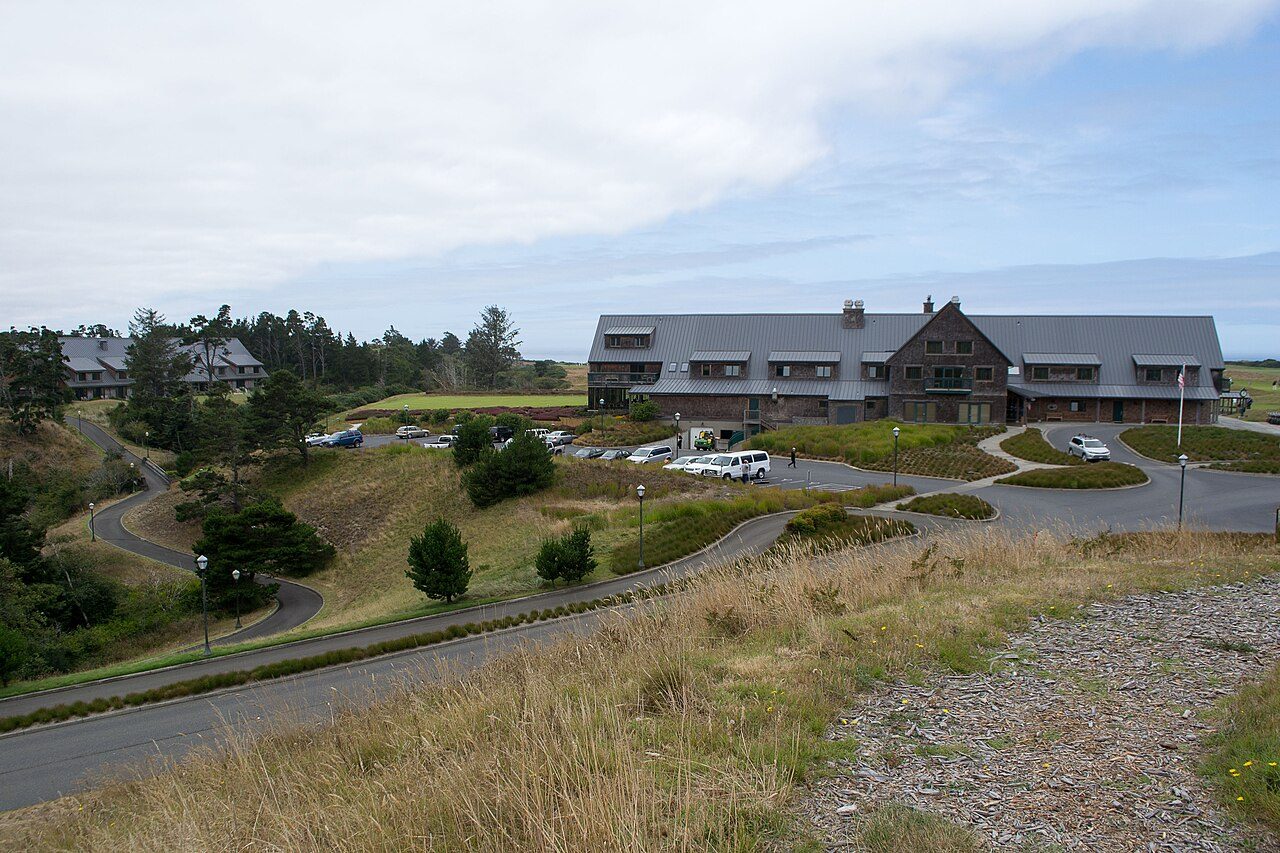
The town of Bandon, about five miles south, is the Plan B, and not a bad one. It has an old town on the harbor, seafood spots, inns and vacation rentals, and the sea stacks at Face Rock are worth an evening walk at low tide. You’ll pay day-guest green fees and drive in each morning, but rooms are easier to find. Coos Bay and North Bend, about half an hour north, have chain hotels and the Mill Casino, and they’re the closest beds to the airport.
How do you get to Bandon Dunes?
Fly to North Bend (OTH), 30 minutes from the resort, on United from San Francisco or Denver. Otherwise fly to Eugene or Medford and drive about 2¾ hours, or to Portland and drive about 4½. Most groups from the East Coast connect through San Francisco or Denver.
North Bend (OTH). Southwest Oregon Regional Airport is the closest airport to the resort, about 30 minutes north. United Express flies there from San Francisco and Denver on regional jets, so most groups from the East and Midwest make one connection. It’s the easiest way in, with two caveats. The flights are small and few, so a canceled or delayed flight on the coast can cost you a day, and in peak season the seats sell out. Book early, don’t schedule your most important round for the afternoon you arrive, and ask the resort about airport transfers when you book your room.
Eugene (EUG) or Medford (MFR). Both are about 2¾ hours by car and have more flights, and often lower fares, than North Bend. From Eugene the drive runs west to the coast and south on Highway 101, which is the prettier route. From Medford you head north on Interstate 5 and then west over the Coast Range on Highway 42. Neither is a hardship in daylight. After a cross-country flight and a late landing, both feel long, and the coastal roads are dark and winding at night.
Portland (PDX). About 4½ hours by car, more in traffic. It makes sense if Portland is part of the trip, or if your home airport has no easy connection through San Francisco or Denver.
Private aviation. North Bend handles private jets, and Bandon itself has a small general-aviation airport.
Do you need a rental car? Not if you fly into North Bend and stay on the resort, because the shuttles cover the property. You’ll want one if you stay in town, drive in from Eugene or Medford, or plan to explore the coast. For bag fees and the ship-or-fly question, our flying with golf clubs guide has the 2026 rules for the big US airlines.
Our how to get to Bandon Dunes guide compares every route with drive times, flight options and what to do when North Bend weather scrambles your plans.
Is Bandon Dunes walking only?
Yes. All five 18-hole courses and both par-3 courses are walking only, all year. You carry your bag, pull a push cart or take a caddie at $100 a bag plus tip. Expect five to six miles a round on sandy, rolling ground, and twice that if you play 36.
Walking isn’t a rule bolted onto the place; the courses were designed for it. Greens sit close to the next tees, the routings follow the land, and a walking round on firm links turf has a natural rhythm that a cart round never does. It’s also why there are no cart paths scarring the dunes. Keiser’s founding idea was golf as it’s played in Scotland and Ireland, and walking was always part of the deal.
You have three ways to get your clubs around:
- Push cart. A row of them waits by the first tee. They roll fine on the firm turf, and on most holes you won’t notice the slopes until the back nine of your second round.
- Carry. A light stand bag is fine for 18 and hard work for 36. Strip it down to the essentials before you leave home.
- Caddie. $100 per bag plus tip, and well worth it for your first loop on each course. Book ahead in peak season, when demand is high.
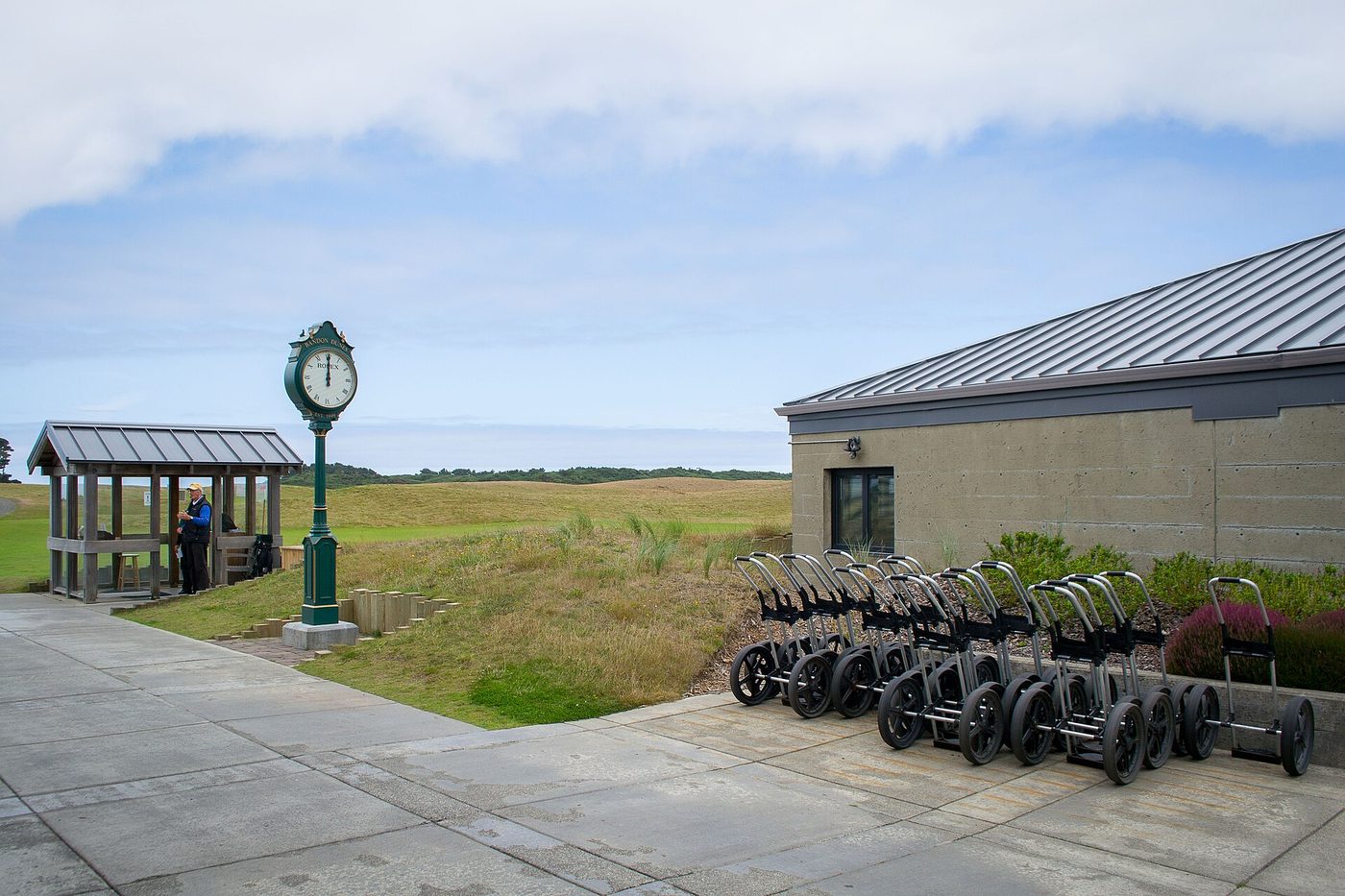
Get ready before you go. Walk 18 holes at home with your bag a few times in the month before the trip. Break in waterproof shoes; new shoes and 36 holes a day are a recipe for blisters. Pack blister plasters anyway. On the first day, play 27 rather than 36 if you’re flying in that morning, and save the hilliest course, Bandon Trails, for a morning when your legs are fresh.
When is the best time to play Bandon Dunes?
June to September has the driest weather and the longest days, but the top rates and a strong afternoon north wind. May and October bring near-summer conditions for a little less, and February, March and November cost $175 to $225. December and January are cheapest, at $130, and wettest.
The resort is open all year, and every season has a case.
- June to September (resort guests $375). Highs mostly in the 60s °F, cool mornings, some fog, and long dry spells. A north wind usually builds through the afternoon, so play your most exposed course in the morning. It stays light until about 9 p.m. in late June, so 36 holes, plus a few on the par-3 course, is easy.
- May and October ($340). In our view, often the best golf of the year: similar temperatures, fewer people and firm conditions. Rain becomes more likely as October goes on.
- February, March, April and November ($175–$225 outside April). Changeable. A calm, 60-degree day can follow a morning squall. The sandy courses drain fast, so they play firm even after rain.
- December and January ($130). The wettest months, with storms rolling in off the Pacific and wind from the south. Sunset comes around 4:45 p.m., which limits you to about 27 holes. Bring proper rain gear and you’ll find the resort much quieter, and the golf costs about a third of the summer rate.
Whatever the month, pack for Scotland, not California. In July, bring a fleece. You’ll wear it.
What to pack for Bandon Dunes
The right gear decides whether a windy, wet day at Bandon is a story or an ordeal. This is the list we’d pack for any month, with notes on what changes in summer:
- A proper rain suit. Jacket and trousers that actually keep water out, not a windbreaker that claims to. Even in summer, a shower can blow through in minutes.
- Two pairs of waterproof golf shoes, both broken in, so one pair can dry while you wear the other. Wet feet on day two ruin day three.
- Layers. A base layer, a quarter-zip, a wind shirt and a fleece or vest. Summer mornings can start in the 50s °F and stay there if the fog sits in.
- A warm hat and rain gloves. A beanie for the wind and two pairs of rain gloves, which grip better when wet than leather.
- A light bag with a rain hood. A stand bag if you’ll carry, a cart bag if you’ll use a push cart. Leave the tour bag at home.
- More balls than usual. The gorse takes its share, and so does the ocean.
- A blister kit, sunscreen and lip balm. The sun burns through fog more than people expect, and you’ll walk 10 or more miles on a 36-hole day.
- Cash for caddie tips.
- Comfortable clothes for dinner. The resort is relaxed, and after 36 holes nobody is dressing up.
An umbrella is optional. On a calm day it helps; in a real Bandon wind it’s a kite.
How many days do you need at Bandon Dunes?
Three nights and four days of golf is the classic first trip: enough to play all five courses once, replay a favorite and fit in the par-3s. Two nights works if you’re combining Bandon with Pebble Beach or Gamble Sands. Five nights suits groups who want to play everything twice.
Here’s the four-night version we’d plan for a first visit in summer:
- Day 1: Fly into North Bend by midday. Play Bandon Dunes in the afternoon, then dinner at McKee’s Pub.
- Day 2: Pacific Dunes in the morning. After lunch, Bandon Preserve or Shorty’s, then the Punchbowl after dinner.
- Day 3: Bandon Trails in the morning on fresh legs, then Old Macdonald in the afternoon, where the wide fairways forgive tired swings.
- Day 4: Sheep Ranch early, before the wind gets up, then replay your favorite at half price in the afternoon.
- Day 5: Fly home, or squeeze in one more morning round if your flight allows.
For three nights, drop the par-3 afternoon and the replay, and play Sheep Ranch on the third afternoon instead. For two nights, play Pacific Dunes, Bandon Dunes and Old Macdonald. With five nights, play everything twice and finish with a sunset round at Bandon Preserve.
Our Bandon Dunes itinerary guide has two-, three-, four- and five-night plans for each season, with the playing order that suits the wind.
Eating, drinking and the rest of the resort
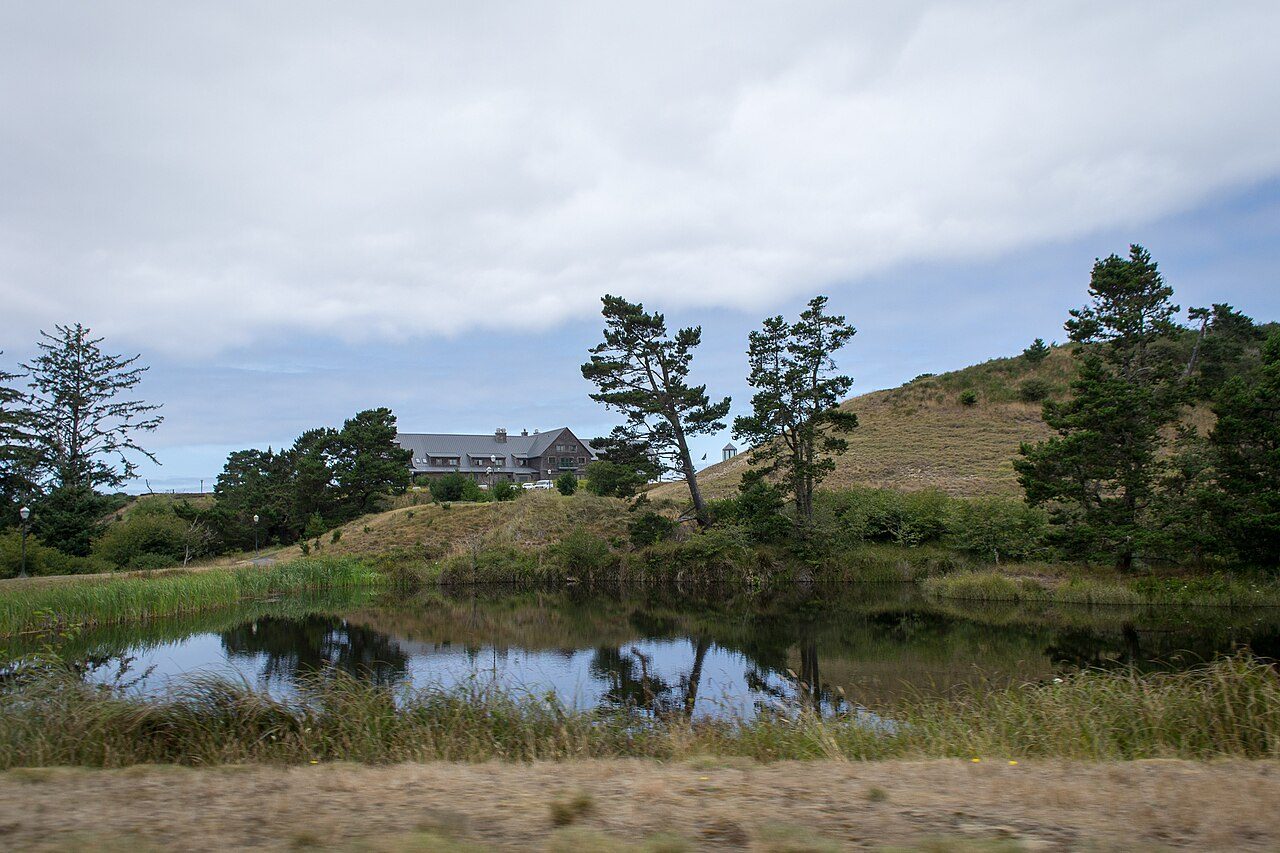
Bandon is a golf resort in the strictest sense. You eat, drink, sleep and play golf, and the place is built around doing those four things well. There’s no shopping village and no casino on site, and that’s the point.
The restaurants are spread around the property so there’s always one near your last green:
- McKee’s Pub is the social center: pub food, Northwest beer and a room full of groups arguing about which course was best.
- The Gallery, in the main lodge, is the closest thing to a formal dinner at the resort.
- Pacific Grill, at the Pacific Dunes clubhouse, has ocean views and is the natural lunch stop between rounds.
- Trails End, the clubhouse for Bandon Trails and Old Macdonald, looks out over the dunes.
Book dinner when you book your room. In peak season, prime tables at the popular spots go early, and the nearest alternative is a drive into town.
Off the property, the town of Bandon calls itself the cranberry capital of Oregon, holds a Cranberry Festival every September, and has an old town on the Coquille River with galleries and seafood on the harbor. Face Rock State Scenic Viewpoint has the best sea stacks on this stretch of coast, and the Coquille River Lighthouse sits in Bullards Beach State Park just north of town. Shore Acres State Park, near Coos Bay, is worth an hour for its gardens and, in winter, for watching storms hit the sandstone cliffs. Gray whales pass the Oregon coast on their migrations in winter and spring.
For non-golfers, be honest: a couple of days is plenty. If a partner is coming, plan around the spa, Face Rock and Shore Acres, and keep the trip short. Bandon is a superb golf trip and a so-so vacation.
Bandon Dunes vs Sand Valley, Pinehurst and Pebble Beach
Bandon usually gets compared with three other American bucket-list resorts. Here’s how they stack up on the things that decide the trip.
| Bandon Dunes | Sand Valley | Pinehurst | Pebble Beach | |
|---|---|---|---|---|
| Where | Southern Oregon coast | Central Wisconsin | North Carolina Sandhills | Monterey Peninsula, California |
| The golf | Five 18s, two par-3 courses | Sand Valley, Mammoth Dunes, Sedge Valley and The Lido, plus short courses | 11 courses, led by No. 2 | Pebble Beach Golf Links, Spyglass Hill, Spanish Bay and more |
| Walking or riding | Walking only | Walking only | Carts or walking | Carts or walking |
| Headline 2026 fee | $130–$375 for resort guests | Varies by course and season | No. 2: $495–$695 for resort guests | Pebble Beach Golf Links: $695 |
| Access | Day guests within 21 days, or premium times further ahead | Resort and day play; check booking rules | No. 2 for resort guests on a package | Resort guests book ahead; others at short notice |
| Best season | June to October | Late spring to fall | Spring and fall | September and October |
| Best for | Golf, and only golf | Midwest groups and forgiving golf | Golf plus a village | One famous round |
How we’d choose:
- Choose Bandon if the golf is the whole point and your group is happy to walk in the wind.
- Choose Sand Valley if your group lives in the Midwest, or if Bandon’s wind sounds like a punishment. It’s run by Mike Keiser’s sons, Michael and Chris, and its wide fairways are kinder to mid-handicappers. Our Bandon Dunes vs Sand Valley guide goes course by course.
- Choose Pinehurst if you want golf plus a walkable village, carts for the people who need them, and spring or fall weather on the East Coast. Our Pinehurst golf trip guide covers it.
- Choose Pebble Beach if one famous round matters more than a week of great ones, and you’re happy to pay for the lodging that comes with it. See our Pebble Beach golf trip guide.
Our best golf resorts in the US ranking puts Bandon first for golf alone, and Pacific Dunes appears on our list of bucket-list golf courses you can actually play.
Where to go after Bandon: the Keiser family of resorts
Bandon’s success changed American golf. Before 1999, the received wisdom was that a destination resort needed carts, real estate and an airport nearby. Bandon proved that golfers would travel a long way to walk great courses on great land, and Mike Keiser and the people around him have been repeating the formula ever since.
If you love Bandon, these are the obvious next trips:
- Sand Valley, Wisconsin. The Keiser family’s inland version, on sand barrens and jack pine in central Wisconsin, run by Michael and Chris Keiser. Its courses are walking only, like Bandon’s, and they’re wider and more forgiving. Our Sand Valley golf resort guide covers it.
- Cabot Cape Breton, Nova Scotia. Keiser was an early backer of Cabot, which now runs resorts from Canada to Scotland, Saint Lucia, Florida and France. The two Cape Breton courses sit on the Gulf of St. Lawrence and play like Bandon with a Canadian accent.
- The next generation. Newer sand-based projects connected to the Keiser name include Wild Spring Dunes in Texas, a Tom Doak design whose full 18 opened to the public on September 8, 2026, at $275 in peak season and walking only, and Rodeo Dunes in Colorado, which opens for public play on May 1, 2027.
The family resemblance is obvious once you’ve played two of them: walking golf, firm turf, minimal real estate and a clubhouse culture built around the pub rather than the pro shop.
The Pacific Northwest golf circuit: Gamble Sands, Chambers Bay, Bend and Coeur d’Alene
Bandon is the reason most golfers fly to the Northwest, but it isn’t the only reason to stay. The region’s golf season runs roughly from June to September, and the best of it falls into four stops.
Gamble Sands, Washington. In dry orchard country above the Columbia River near Brewster, David McLay Kidd built one of the most enjoyable courses in the West: huge fairways, firm turf and greens that feed the ball toward the hole. In August 2025 the resort added Scarecrow, a second 18 by McLay Kidd, and there’s a short course as well. It’s about 3½ hours from Seattle, or about an hour and a quarter from the airport at Wenatchee, and it’s sunnier and hotter than the coast. Our Gamble Sands guide covers both courses, the lodging and the drive.
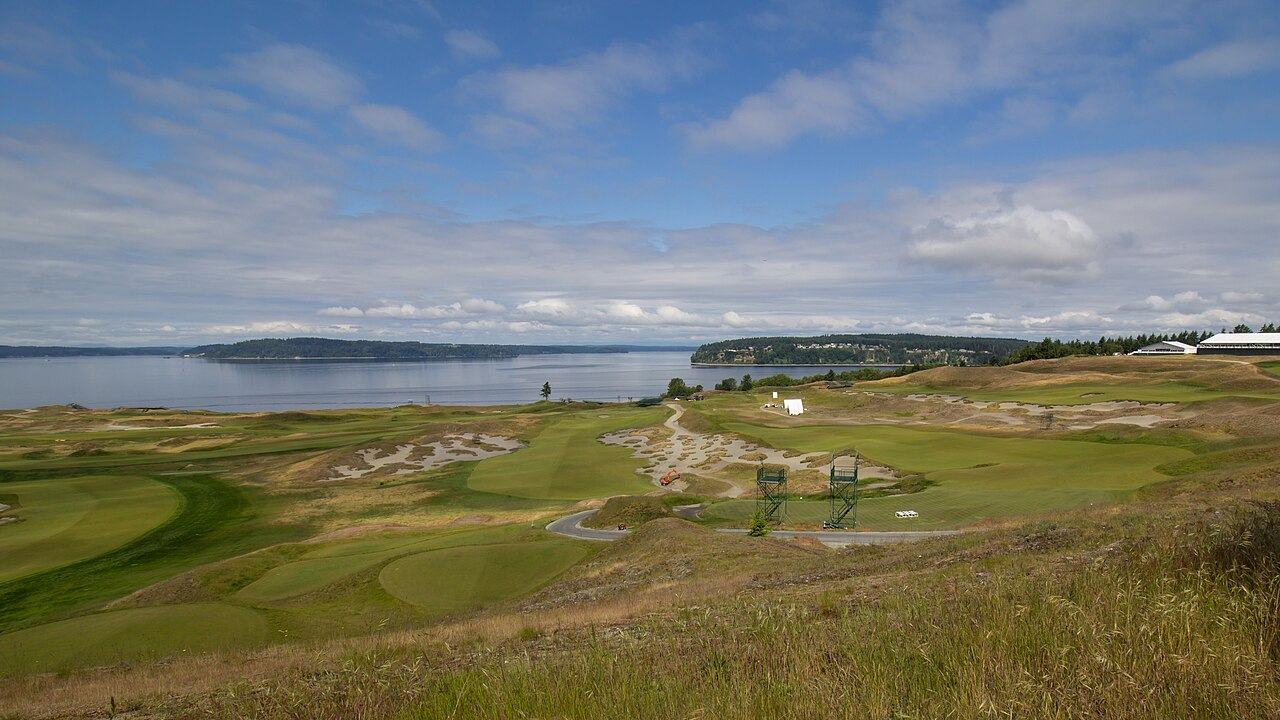
Chambers Bay, Washington. A county-owned, links-style course on the shore of Puget Sound in University Place, near Tacoma, designed by Robert Trent Jones Jr. It hosted the 2015 U.S. Open, won by Jordan Spieth. It’s walking only, the fescue plays fast, and freight trains rumble along the water below the course. It’s about 45 minutes from Seattle-Tacoma airport. Pierce County residents pay less than visitors, so check the course’s own rate page for current non-resident fees, or read our Chambers Bay green fee guide.

Bend and Central Oregon. East of the Cascades, Bend sits in high desert among ponderosa pines, with dry summers and a cluster of resort golf: Tetherow (another McLay Kidd design), Pronghorn’s Nicklaus course, the courses at Sunriver including Crosswater, Black Butte Ranch and Brasada Ranch. Redmond’s airport, about 25 minutes from Bend, has nonstops from several Western hubs. Bend is about 4½ hours from Bandon by car, which makes a coast-and-desert week possible.
Coeur d’Alene, Idaho. The Coeur d’Alene Resort’s course is famous for the floating green on its 14th hole, a movable island you reach by boat. It’s about 45 minutes from Spokane’s airport and makes a good add-on to a Gamble Sands trip.
A few more names reward a detour if you’re nearby: Wine Valley in Walla Walla and Palouse Ridge in Pullman, both in eastern Washington; Silvies Valley Ranch in eastern Oregon, where goats carry your clubs on one of the short courses; and the public Ghost Creek course at Pumpkin Ridge, outside Portland.
Three combinations that work well:
- Seattle, Chambers Bay and Gamble Sands in four or five days, flying into Seattle and out of Wenatchee or Spokane.
- Portland, Bandon and Bend in a week, with the long drive broken up by a night on the coast.
- Bandon and Pebble Beach in one trip, flying between them through San Francisco.
Timing matters more in the Northwest than people expect. West of the Cascades, at Bandon and Chambers Bay, summer is cool, dry and reliably green. East of the mountains, Bend, Gamble Sands and Coeur d’Alene can run into the 90s °F in July and August, so book morning tee times there. Late summer is also wildfire season across much of the West, and smoke can drift over courses for days at a time, so build a little flexibility into an August or September trip and check air-quality forecasts before you drive.
Our Pacific Northwest golf trip guide routes all of these with drive times and the best order to play them.
Planning a Bandon buddies trip
Bandon may be the best buddies-trip destination in America, because it removes every decision except who buys the first round. There’s nothing to do but play, eat and argue, and the resort is set up for exactly that.
A few things make a group trip run smoothly:
- Rooming. Lodge rooms suit solo golfers and groups who snore. The cottages sleep four to eight and give a group a shared living room for the post-round debrief.
- Tee times. Groups go out in fours, so plan in multiples of four. With eight, book two groups back to back and swap partners each round.
- Formats. Old Macdonald is the best course for match play, the par-3 courses are made for closest-to-the-pin contests, and the Punchbowl after dinner is where the trip’s real money changes hands. A Ryder Cup-style team format over three days keeps everyone interested even when the wind ruins their swing.
- Money. Let one person book the rooms and collect deposits, and agree up front how replays, caddies and dinners get split. Bring cash for caddie tips.
Our buddies golf trip playbook covers the rest, from picking dates to keeping the group chat under control.
Bandon Dunes mistakes to avoid
Most Bandon trips that go wrong go wrong for the same few reasons:
- Underestimating the walk. Thirty-six holes a day on sand, for three or four days in a row, is a lot. Train for it at home.
- Packing for summer. July highs in the 60s °F and an afternoon wind mean you’ll want a fleece and a rain suit. Pack for Scotland.
- Missing the drawing windows. If you want a summer week, find out when the next registration window opens and put it in your calendar.
- Tight connections. Leave slack around North Bend flights, and don’t book your most important round for the afternoon you land.
- Playing Bandon Trails as a second round. It’s the hilliest walk at the resort. Play it in the morning, ideally on your windiest day.
- Ignoring the wind forecast. In summer, play the exposed courses (Sheep Ranch, Pacific Dunes and Bandon Dunes) early, before the north wind builds.
- Skipping the par-3 courses. Some of the most fun golf at the resort costs $60 to $125.
- Not booking dinner. In peak season the good tables go early.
- Driving from Portland after a red-eye. Four and a half hours on tired eyes is a bad way to start a golf trip.
Every guide to Bandon Dunes and Pacific Northwest golf
This page is the hub. Each guide below goes deeper on one part of a Bandon or Pacific Northwest golf trip.
Bandon Dunes costs and booking
- Bandon Dunes green fees: every 2026–27 rate for resort guests and day guests
- Bandon Dunes lodging drawing: how the lottery works and what to do if you aren’t drawn
- Bandon Dunes trip cost: summer, shoulder and winter budgets per golfer
The courses and the trip
- Bandon Dunes courses ranked: all five 18s and the par-3 courses, in order
- How to get to Bandon Dunes: North Bend, Eugene, Medford and Portland compared
- Bandon Dunes itinerary: two- to five-night plans by season
The rest of the Pacific Northwest
- Pacific Northwest golf trip: routes through Oregon, Washington and Idaho
- Gamble Sands: Gamble Sands, Scarecrow and the short course
- Chambers Bay green fee: what visitors pay at the 2015 U.S. Open course
Frequently asked questions
How many golf courses are at Bandon Dunes?
Five 18-hole courses: Bandon Dunes, Pacific Dunes, Bandon Trails, Old Macdonald and Sheep Ranch. There are also two par-3 courses, the 13-hole Bandon Preserve and the 19-hole Shorty’s, plus the Punchbowl putting course. All of them are walking only.
Can you play Bandon Dunes if you don’t stay there?
Yes. Day guests can book within 21 days of play at $180 to $425 in 2026, or book further ahead as premium day guests, for times at 10 a.m. or later from April to mid-November, at up to $475. Resort guests pay less and get first choice of times.
How much does it cost to play Bandon Dunes?
In 2026, resort guests pay $130 in December and January, $175 to $225 in February, March and November, $340 in May and October, and $375 from June to September. Same-day replays are half price, and caddies cost $100 per bag plus tip.
How far in advance can you book tee times at Bandon Dunes?
Resort guests reserve tee times with their lodging, so they can book as far ahead as their room. Day guests can book within 21 days of play. Premium day-guest times, at 10 a.m. or later from April to mid-November, can be booked 21 or more days ahead.
Do you need a caddie at Bandon Dunes?
No. Caddies are optional, at $100 per bag plus tip, and push carts wait by the first tee. A caddie is worth it for your first round on each course, because the greens are hard to read and the wind changes every club selection.
Can you ride a golf cart at Bandon Dunes?
No. Every course at Bandon is walking only, all year. If someone in your group has a medical condition that makes walking impossible, contact the resort before you book to ask what’s possible.
What is the best course at Bandon Dunes?
Pacific Dunes, by Tom Doak, tops most lists, including ours. Old Macdonald and the original Bandon Dunes are close behind, Sheep Ranch has the most ocean views, and Bandon Trails, by Coore and Crenshaw, has plenty of fans who rank it first.
What’s the weather like at Bandon Dunes?
Cool and often windy. Summer highs are mostly in the 60s °F, with fog some mornings and a north wind most afternoons. Winter brings rain, Pacific storms and wind from the south. Pack layers and rain gear in any month.
What is the closest airport to Bandon Dunes?
Southwest Oregon Regional Airport in North Bend (OTH), about 30 minutes north, with United flights from San Francisco and Denver. Eugene and Medford are about 2¾ hours away by car, and Portland about 4½.
How does the Bandon Dunes lottery work?
For busy periods, you register during a set window, and a random drawing decides the order in which requests are handled. If you’re selected, you get an email with your place in line and later a call from a reservationist to book. Periods outside the drawings book the normal way.
Is Bandon Dunes good for high handicappers?
Yes, with the right choices. Sheep Ranch has no bunkers and wide fairways, Old Macdonald’s fairways are enormous, and the par-3 courses suit everyone. Play the forward tees, putt from off the green, and accept that the wind costs everyone a few shots.
Is Bandon Dunes open all year?
Yes. The courses are open year-round, and winter is the cheapest time to play, at $130 a round for resort guests in December and January. Expect rain, wind and short days.
Can you play 36 holes a day at Bandon Dunes?
Yes, and most visitors do. A same-day replay costs half the rate, so a second summer round costs a resort guest $187.50, and in June it stays light until about 9 p.m. In December and January, short days limit you to about 27 holes. Plan for the walk: 36 holes is 10 or more miles.
How many days do you need at Bandon Dunes?
Three or four nights is right for a first trip. That’s enough to play all five 18-hole courses once, replay a favorite at half price and fit in a par-3 round. Two nights covers the three best-known courses; with five, you can play everything twice.
Is Bandon Dunes good for a solo golfer?
It’s one of the best bucket-list resorts in the country for a solo golfer. Single lodge rooms are built for one person, every course is set up for walking, and the culture is golf first, so joining another group on the first tee is normal. Book your room and tee times together and ask to be paired.
What should I pack for Bandon Dunes?
A full rain suit, two pairs of broken-in waterproof shoes, layers including a fleece, a warm hat and rain gloves, a light bag with a rain hood, plenty of balls, a blister kit and cash for caddie tips. Pack the same list in July; summer highs are mostly in the 60s °F.
Is Bandon Dunes better than Pebble Beach?
For the golf, many who’ve played both would say yes. Bandon has five world-class courses, and a peak-season round there costs a resort guest $375, against $695 for one round at Pebble Beach Golf Links in 2026. Pebble has the more famous single course, calmer weather and Carmel next door, so the better choice depends on the trip you want.
Cabot Cape Breton in Nova Scotia is the East Coast’s answer to Bandon. It has two 18-hole courses, Rod Whitman’s Cabot Links and Coore and Crenshaw’s Cabot Cliffs, plus a par-3 course, in the small town of Inverness on Cape Breton Island. Its 2026 resort-guest rates ran from CA$220 to CA$450, about $160 to $330, between May 8 and October 25. For golfers in the East it’s a much shorter trip, and our Canada golf trips guide compares the two.
Sources
Primary sources and official pages, checked September and October 2026.
- Bandon Dunes Golf Resort, official site: bandondunesgolf.com
- Chambers Bay, official site: chambersbaygolf.com
- Gamble Sands, official site: gamblesands.com
- Also consulted: Golf For Kings on Bandon’s 2026 rate tiers; GOLF.com on the Bandon lodging lottery and on caddie tipping; Wikipedia on the resort’s history and championships; airportroutes.com on North Bend’s 2026 routes; The Birdie Report on Pinehurst No. 2 (2026); JEL Golf Travel’s 2026 trip-cost tiers; GolfPass on the opening of Scarecrow at Gamble Sands.
Image credits
| Image | Credit and license |
|---|---|
| Bandon Dunes Resort-7 (featured) | Photo by Visitor7, CC BY-SA 3.0, via Wikimedia Commons. |
| First tee and push carts, Bandon Dunes | Photo by Visitor7, CC BY-SA 3.0, via Wikimedia Commons. |
| Bandon Dunes Resort-4 | Photo by Visitor7, CC BY-SA 3.0, via Wikimedia Commons. |
| Bandon Dunes Resort-1 | Photo by Visitor7, CC BY-SA 3.0, via Wikimedia Commons. |
| Chambers Bay Golf Course (17563878454) | Photo by Atomic Taco from Seattle, WA, USA, CC BY-SA 2.0, via Wikimedia Commons. |
| Jordan Spieth after winning the 2015 U.S. Open | Photo by FOX Sports, CC BY 3.0, via Wikimedia Commons. |